If you know absolutely nothing about lobster hunting, I would advise you to initially read my first article.
I have also decided to expand this series into three parts, this being the second installment.
In my early years of lobster hunting, I spent much time, effort and money diving off of beaches and paying for boats, only to come home humiliated and disgraced with an empty game bag.
Buying the extra hunting gear, obtaining the correct permits and practicing your lobster pinning techniques are not enough to guarantee lobster success.
Your hunting strategy must be tailored to the boat you’re on, the beach you’re diving off of and the time of the season.
Assuming you already know the lobster hunting basics, you are ready to go out and stuff your bags!
Go To Where The Lobsters Are
Sounds pretty obvious, huh?
During the beginning of the season (October to November), lobsters tend to be in shallow water between 10 and 40 feet.
As Winter storms set in, lobsters go deeper (60-100 feet and more) to seek refuge from the pounding surf.
Towards the end of the season (February to March), lobsters tend to go back in the shallows.
A lot of lobster hunters won’t tell you where they go, but most will share how deep they’ve been catching them.
Throughout the season, always pay attention to how deep the lobsters are.
If your first dive is in 20 feet, but don’t see any lobster, try another good spot in maybe 40 or 50 feet for your second dive.
If the first spot was very lucrative in lobsters and you didn’t scare them all back in their holes, stay for the second dive.
Keeping Your Lobsters – Prevent Escapes!
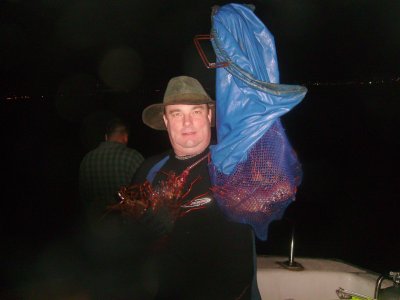
It is quite common for an experienced lobster hunter to bring along a novice.
Usually, the senior grabs and the junior holds, opens and keeps his eye on the bag.
Just because you bag a lobster, doesn’t mean that lobster is going to give up on life.
Once you open that bag to put your second lobster of the dive in, your first lobster will try and shoot right out; they are often successful.
Shake your first lobster down to the bottom of the bag, position the second lobster at the bag’s entrance, open, insert and close right away.
After you’ve caught a few lobsters, they tend to cling onto one another and your risk of escape diminishes.
Shore Diving For Lobsters?
All throughout lobster season, especially at the beginning, along the cliffs of Palos Verdes lights can be seen from several dozen lobster hunters.
The most famous place to go lobster hunting from the shores of Palos Verdes is Malaga Cove, aka “The Nursery.”
A name well deserved, because a good night at Malaga Cove is actually catching a legal lobster.
The shore is easily accessible by anyone in moderately good shape, so a lot of times this spot gets picked clean.
But, it’s the perfect place to test your lobster hunting and night diving skills; just make sure you don’t park in the lot between 9 PM and 5 AM.
The harder it is to get to a spot from shore, the less likely that spot has been picked clean; from Mabilu to Orange County, there are still some good places to hunt lobster from shore.
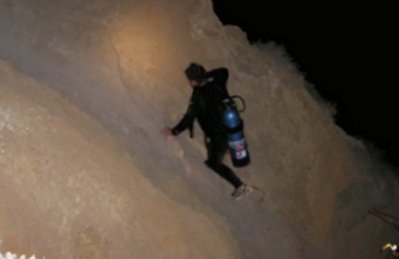
SCUBA diving is the easy part; the challenge is the walk and sometimes crawl down goat trails to the shoreline in darkness.
A warning about Palos Verdes though; over the years a group called “The Bay Boys” (aka “The Gay Boys”) have been territorial over their local surfing spots.
Last season, these 40 year old, punk, low-life losers, who still live with their parents in Palos Verdes, started targeting lobster hunters along the cliffs by slashing tires.
Boat Diving For Lobsters
Access to a good, reliable, boat is key to catching lobsters on a consistent basis.
Every single charter boat goes out on Opening Night.
All along the coast of Catalina and the rest of Southern California, hundreds of private and commercial boats anchor off shore waiting for midnight – the start of lobster season.
The next night, barely a boat can be seen; for the rest of the season; only the serious, regular lobster divers and hoop netters are out.
Dive shops very rarely charter lobster boats after opening night.
A Warning About Lobster Diving From Large Charter Boats
The larger boats that accommodate 20 to 35 divers, are usually chartered by dive shops and tend to cater to “first time” lobster hunters, who may never have even done a night dive.
The boat, many times, will also be needed for a day charter later in the morning, so to save time the boat may anchor in one spot, all night long.
So, basically, you are anchored in one area, with 20 to 35 novice lobster hunters jumping overboard for four hours and scaring all the lobsters back into their holes.
Your Basic Strategy For Lobster Hunting From Large Boats
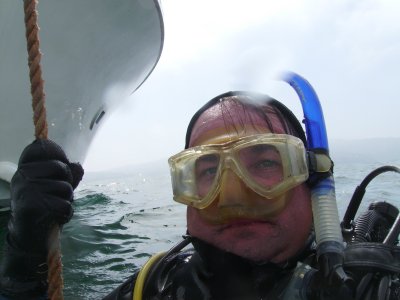
Be the first diver overboard and check the anchor the first thing after you submerge.
For whatever reason, on big or small boats, check the anchor first; I’ve caught many lobsters just by doing that.
After that, swim against the current and cover as much ground as possible as early as possible in the dive.
If the boat doesn’t plan to move to another spot, your second dive will probably be futile.
Small Boats Are Best
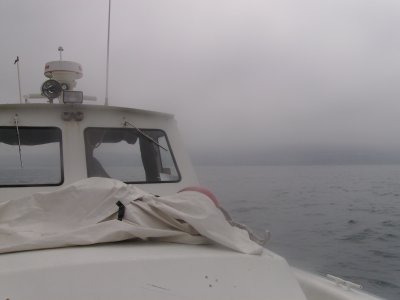
Ideally, a small boat with two to eight divers is ideal for lobster hunting.
There are many small professional boats that can be chartered for about $250 a night; find five other divers to split the cost, and you have a descent hunting trip.
As long as the boat is regularly chartered for fishing and diving, the boat Captain and crew should have a good idea where to hunt lobsters.
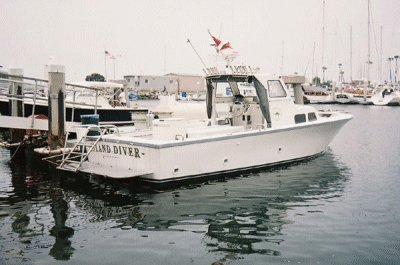
Photo By Juan Twenty
The Island Diver out of King Harbor is one such charter.
You should still keep in touch with a core group of lobster hunters to keep tabs on how deep the lobsters are, since the charter boat Captain may not know.
Next Week: What to do with your lobsters!
Photo tips on posing with your trophy, how to de-vein the tail, 2008 season predictions and lobster recipes.