Click Here To Go To Psycho Solo Diver
  • HOME
  • You are currently browsing the archives for the Thoughts On Diving category.

  • Categories

  • « Previous PageNext Page »

    September 12, 2008

    What To Do With Your Lobsters & 2008 Season Predictions

    So now, after reading The Basics of California Lobster Hunting On SCUBA and The Secrets To A Successful Southern California Lobster Season you are sure to come back from your trips with a bag full of lobsters.

    So, once caught, what the hell do you do with them?

    Take Pictures To Prove That You Are Macho

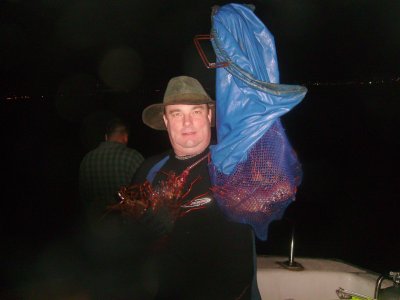
    I always pose with my bugs; I look so macho holding something that looks like a giant cockroach.
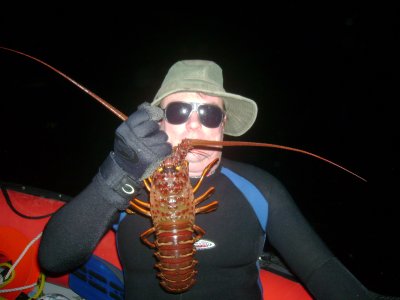
    Holding an average sized lobster by an antennae and close to the camera makes it look a lot larger

    TIP: Holding an average sized lobster by an antennae and close to the camera makes it look a lot larger.

    Also, wearing sunglasses at night makes you look even more cool!
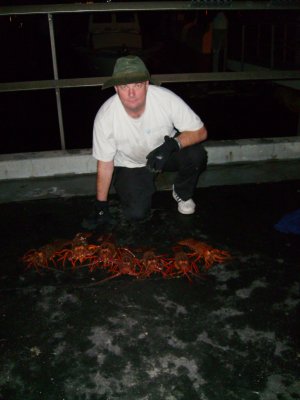
    Do I look macho with my lobsters, or what?

    The “line your lobsters up and pose with them” also makes even the novice of lobster hunters look macho.

    Keeping Your Lobsters In Transit

    If you keep your lobsters in a net bag, they are usually able to live for 24 to 48 hours out of the water.

    Putting them in fresh water or keeping them in a plastic bag will kill them fairly quickly.

    I know of someone who shipped live lobsters via next day UPS in a box with holes through it, lined with wet newspaper; they arrived alive.

    Putting A Lobster Out Of Its Misery

    Lobsters live such miserable lives – hiding in holes during the day, and foraging for rotting flesh during the night – that if they could talk, they would probably thank you for killing them.

    Boiling Alive:

    So how do you know if a lobster is still alive?

    As long as the carapace is still attached to the tail and it doesn’t smell like rotting seafood, it might still be alive.

    If true, even the most lifeless of lobsters will start to move when you hold it above a boiling pot of water…
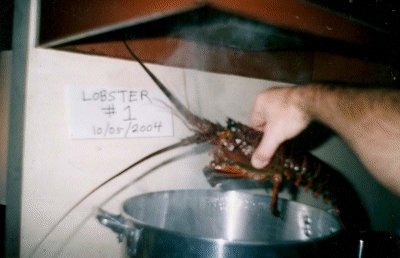
    Lobsters wake up after they feel steam

    For those who are going to boil your lobsters and are not sadistic, make sure it’s a rolling boil; if not, your lobster will spend the last few minutes of its life swimming backwards in frantic circles around your pot until the life slowly and painfully drains from it.

    If that happens, when you die, you will reincarnate into a spiny lobster and face the same torment.
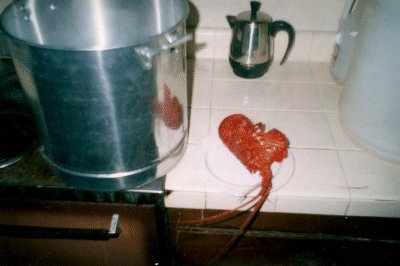
    Cooked lobsters will turn orange

    Boil the lobster for 10 to 20 minutes depending on its size; it will turn a bright orange when done.

    I put salt and raw garlic in the water to enhance the flavor.

    Remove the tail from the carapice and split the tail down the center; remove its “vein” (aka butt hole) before eating.

    I personally would not eat a dead, whole lobster; that’s why I prefer to tail and freeze my catch to eat later…

    Tailing and Freezing

    Remember, you have to keep the lobsters whole until you are on shore!

    Usually, by that time, the lobsters are in a great amount of shock and are preparing to die anyway.

    So with your gloves on, grab the carapace with one hand and the tail with your other – pull and twist the tail off.

    Scrape any residual guts off the top of the tail.

    Some hunters will try and be humane by smashing the lobster’s head with a hammer first, but they don’t have much of a brain, anyway.

    Now, to help in the preservation process…

    De-Assing The Tail

    I had a hard time figuring this part out for a while, until I got a demonstration from the Divevets’ ass expert.

    “The vein” down the middle of the lobster is actually its butt hole; you should remove it.

    Break off one of the lobster’s antennas, take the base (large end) of the antenna, insert it up the asshole about a quarter to a half inch, give it a twist and pull the antenna back out.

    The whole butt hole vein should follow.

    Need pictures?

    Here is an illustrated guide on how to tail and de-ass your lobsters.

    Freezing Your Lobster Tails
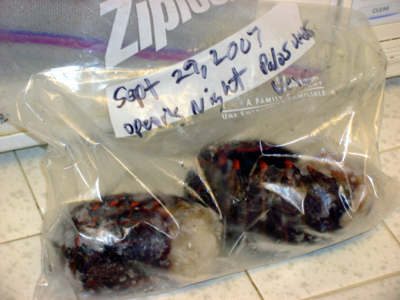
    Frozen lobster tails

    I take a freezer bag and mark on the outside with a sharpie, the date, where caught and the words “raw lobster – de-veined” (that helps if I give them away) and put them in my freezer; they have stayed good for nine months in that condition.

    Some hunters will vacuum pack the tails in the bag, but I hear the tail’s spikes puncture the plastic.

    Remember, the DFG state that you cannot have more than seven lobster tails in your possession at one time, including your freezer; but, I have heard of hunters giving them away to family members in their household.

    When you’re ready to eat the tails, thaw them in warm water for 10 minutes or so; the shell will turn an orange color in the process.

    2008 Lobster Season Predictions

    Since I do so well at the race track, I’ll lend my talent to predicting the 2008 lobster season.

    If the weather stays moderate, with only a few storms late this year, the 2008 lobster season should be better than last year’s, but not as good as the 2006 season.

    During the 2006 season, divers and hoop netters were limiting on practically every trip.

    That cleaned a lot of the bugs from the coast, leading to speculation that there was a lobster shortage in the 2007 season; I think there was only a shortage of lobsters caught.

    Storms last season continued into February and March, keeping the lobsters deep.

    Late in the season, the lobsters weren’t shallow, and they weren’t as “deep” as 120 feet; but, in talking with some tech divers who dove the Sacramento wreck, which rests at 300 feet, I was assured, “the lobsters are all down at 240 feet and deeper.”

    So, last season, they were chased deeper and never had a reason to come back shallow before the season ended.

    With the weather having stayed fairly mild this summer and lobsters being spotted in the shallows recently, we should have a good 2008 season.

    Lobster Recipes

    I personally don’t prepare lavish lobster recipes, but I have never had a complaint.

    Boil and eat:

    If you’ve boiled your lobsters alive, just keep the heat on until they’re done; again, 10 to 20 minutes depending on the size, just like in the example above.

    If you over cook them, the meat will be mushy.

    Cut down the middle of the shell lengthwise, split and – if you haven’t done this yet – take the vein out.

    Serve American style with melted butter, or Mexican style with Tapatio sauce.

    Bake and eat:

    Take a thawed or raw, de-asses lobster tail, split it lengthwise and put it on a large sheet of aluminum foil.

    I put butter, garlic and salt on top of the meat; you can also put olive oil, Parmesan cheese, or whatever you think might go good with lobster.

    Wrap the tails in the foil and put in the oven for 10 to 20 minutes at about 400 degrees Fahrenheit; the time depends on the size of the tails.

    The last five minutes, unwrap the tails, add more butter or olive oil and let the top brown.

    Be sure not to let the meat get too dehydrated, otherwise it will stick to the shell.

    Lobsters do not make an entire meal by themselves.
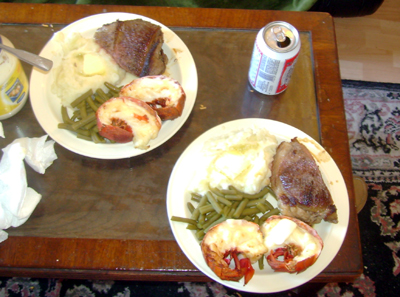
    The all American Lobster Meal

    I serve mine with steak, green beans and mashed potatoes; so American is this dish, that I have given it the name “George Bush’s Favorite Meal.”

    I will collect and post other recipes throughout the season, as I obtain them.

    An official Department of Fish and Game lobster brochure can be found here.

    If you find yourself in the situation of having more than seven lobster tails at one time this season, and no friends to give them to, you can send excess frozen tails to the address on my contact page; please send me an email so I will be sure to pick them up before they thaw and rot.

    Good luck this season!
    September 3, 2008

    The Secrets To A Successful Southern California Lobster Season

    If you know absolutely nothing about lobster hunting, I would advise you to initially read my first article.

    I have also decided to expand this series into three parts, this being the second installment.

    In my early years of lobster hunting, I spent much time, effort and money diving off of beaches and paying for boats, only to come home humiliated and disgraced with an empty game bag.

    Buying the extra hunting gear, obtaining the correct permits and practicing your lobster pinning techniques are not enough to guarantee lobster success.

    Your hunting strategy must be tailored to the boat you’re on, the beach you’re diving off of and the time of the season.

    Assuming you already know the lobster hunting basics, you are ready to go out and stuff your bags!

    Go To Where The Lobsters Are

    Sounds pretty obvious, huh?

    During the beginning of the season (October to November), lobsters tend to be in shallow water between 10 and 40 feet.

    As Winter storms set in, lobsters go deeper (60-100 feet and more) to seek refuge from the pounding surf.

    Towards the end of the season (February to March), lobsters tend to go back in the shallows.

    A lot of lobster hunters won’t tell you where they go, but most will share how deep they’ve been catching them.

    Throughout the season, always pay attention to how deep the lobsters are.

    If your first dive is in 20 feet, but don’t see any lobster, try another good spot in maybe 40 or 50 feet for your second dive.

    If the first spot was very lucrative in lobsters and you didn’t scare them all back in their holes, stay for the second dive.

    Keeping Your Lobsters – Prevent Escapes!

    A macho diver with his lobsters

    It is quite common for an experienced lobster hunter to bring along a novice.

    Usually, the senior grabs and the junior holds, opens and keeps his eye on the bag.

    Just because you bag a lobster, doesn’t mean that lobster is going to give up on life.

    Once you open that bag to put your second lobster of the dive in, your first lobster will try and shoot right out; they are often successful.

    Shake your first lobster down to the bottom of the bag, position the second lobster at the bag’s entrance, open, insert and close right away.

    After you’ve caught a few lobsters, they tend to cling onto one another and your risk of escape diminishes.

    Shore Diving For Lobsters?

    All throughout lobster season, especially at the beginning, along the cliffs of Palos Verdes lights can be seen from several dozen lobster hunters.

    The most famous place to go lobster hunting from the shores of Palos Verdes is Malaga Cove, aka “The Nursery.”

    A name well deserved, because a good night at Malaga Cove is actually catching a legal lobster.

    The shore is easily accessible by anyone in moderately good shape, so a lot of times this spot gets picked clean.

    But, it’s the perfect place to test your lobster hunting and night diving skills; just make sure you don’t park in the lot between 9 PM and 5 AM.

    The harder it is to get to a spot from shore, the less likely that spot has been picked clean; from Mabilu to Orange County, there are still some good places to hunt lobster from shore.

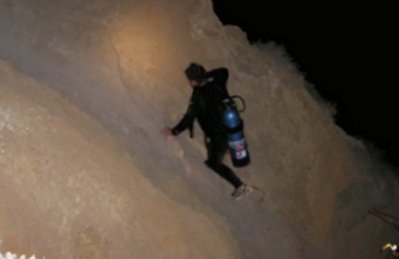
    Rock climbing with SCUBA gear

    SCUBA diving is the easy part; the challenge is the walk and sometimes crawl down goat trails to the shoreline in darkness.

    A warning about Palos Verdes though; over the years a group called “The Bay Boys” (aka “The Gay Boys”) have been territorial over their local surfing spots.

    Last season, these 40 year old, punk, low-life losers, who still live with their parents in Palos Verdes, started targeting lobster hunters along the cliffs by slashing tires.

    Boat Diving For Lobsters

    Access to a good, reliable, boat is key to catching lobsters on a consistent basis.

    Every single charter boat goes out on Opening Night.

    All along the coast of Catalina and the rest of Southern California, hundreds of private and commercial boats anchor off shore waiting for midnight – the start of lobster season.

    The next night, barely a boat can be seen; for the rest of the season; only the serious, regular lobster divers and hoop netters are out.

    Dive shops very rarely charter lobster boats after opening night.

    A Warning About Lobster Diving From Large Charter Boats

    The larger boats that accommodate 20 to 35 divers, are usually chartered by dive shops and tend to cater to “first time” lobster hunters, who may never have even done a night dive.

    The boat, many times, will also be needed for a day charter later in the morning, so to save time the boat may anchor in one spot, all night long.

    So, basically, you are anchored in one area, with 20 to 35 novice lobster hunters jumping overboard for four hours and scaring all the lobsters back into their holes.

    Your Basic Strategy For Lobster Hunting From Large Boats

    Be the first diver overboard and check the anchor the first thing after you submerge.

    For whatever reason, on big or small boats, check the anchor first; I’ve caught many lobsters just by doing that.

    After that, swim against the current and cover as much ground as possible as early as possible in the dive.

    If the boat doesn’t plan to move to another spot, your second dive will probably be futile.

    Small Boats Are Best

    Ideally, a small boat with two to eight divers is ideal for lobster hunting.

    There are many small professional boats that can be chartered for about $250 a night; find five other divers to split the cost, and you have a descent hunting trip.

    As long as the boat is regularly chartered for fishing and diving, the boat Captain and crew should have a good idea where to hunt lobsters.

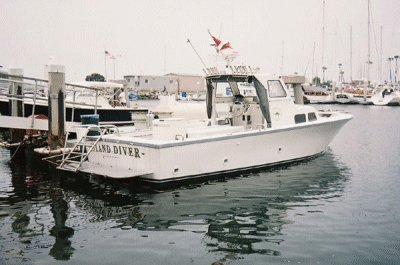
    The Island Diver out of King Harbor
    Photo By Juan Twenty

    The Island Diver out of King Harbor is one such charter.

    You should still keep in touch with a core group of lobster hunters to keep tabs on how deep the lobsters are, since the charter boat Captain may not know.

    Next Week: What to do with your lobsters!

    Photo tips on posing with your trophy, how to de-vein the tail, 2008 season predictions and lobster recipes.

    « Previous PageNext Page »


    RSS Subscribe
    Subscribe!


    ©Copyright 2002-2026 Psychosolodiver.com. All Rights Reserved. However, if you are going to steal anything from this site, please give me credit and link back.